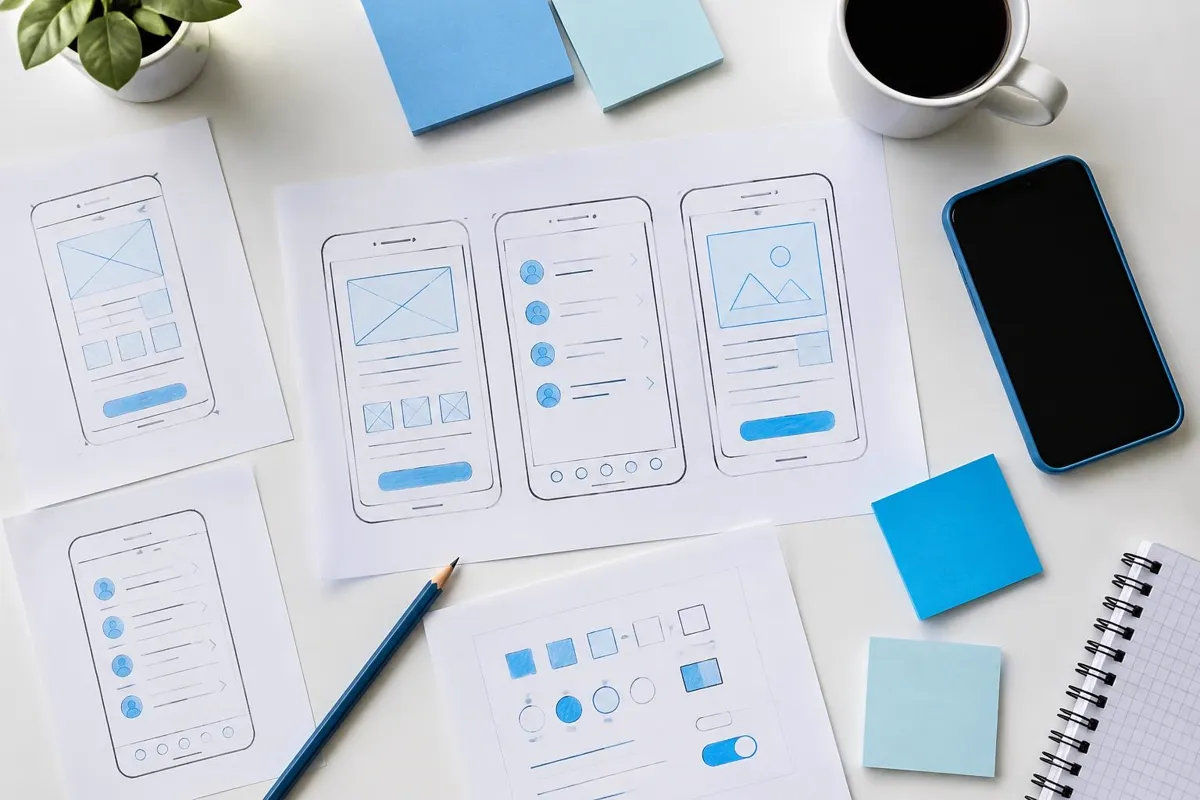
Begin with a customer need, not a screen count
Identify who needs the product and what they cannot do comfortably today. A distributor in Lahore might need retailers to reorder stock, while a service business might need appointment requests. Describe the difficulty and the intended outcome before drawing menus or collecting feature ideas.
Consider whether a mobile-friendly website or an existing business tool would be enough. Installing an application introduces an extra step for customers and ongoing support for your team. An app makes more sense when repeat usage or device features justify those responsibilities.
Give the first release a complete purpose
Outline a single journey from opening the application to finishing a useful task. Include the information users need, confirmation messages and recovery from failed requests. For audiences in Pakistan, decide whether English, Urdu or both are necessary, based on actual user needs rather than assumptions.
Keep optional features separate from launch essentials. Protecting personal information, handling access permissions and supporting customers remain necessary in a small release. If orders involve JazzCash or Easypaisa, confirm provider eligibility and integration requirements before making payment functionality part of the promised scope.
Evaluate platforms against real usage
Choose between Android, iOS and shared-code development by looking at the devices your intended customers use. Assess camera access, notifications, connectivity and any offline tasks. Test weak-network behaviour explicitly so users know whether a request has been saved, sent or rejected.
Include maintenance in the platform discussion. Establish ownership of developer accounts, responsibility for dependency updates and the supported operating-system versions. Shared code does not eliminate separate device checks, and submitting an application to a store does not guarantee that it will pass review.
Make learning part of the launch plan
Define which observations will guide the next release. Task completion, repeated support questions and points of abandonment can all be useful. Combine carefully planned analytics with user conversations, and avoid collecting information simply because an analytics tool makes it available.
Prepare a brief covering the audience, essential journey, integrations and constraints. TechSyncs MVP planning and app interface design can help turn that brief into a testable scope. The aim is a manageable first product that answers useful questions before the business invests in additional features.
Plan your next move
MVP Planning and Development · App Interface and Experience Design · Talk through your requirements with TechSyncs
A worked MVP scope: a repeat-order tool
Consider an illustrative distributor whose customers regularly reorder familiar products. A useful first journey could let a verified customer find an item, choose a quantity, send an order request and see confirmation. An internal user then reviews the request and updates its status. This is a planning example, not a TechSyncs client result.
Recommendations, loyalty points and complex delivery maps can wait if they do not solve the immediate problem. However, invalid quantities, unavailable stock, duplicate requests and permission checks cannot simply be deferred. Write what should happen in each case. If an integration is uncertain, test that connection before promising the full workflow.
Use this app brief checklist
- Audience: who will use the app, how often, and on which devices?
- Core task: what can a user complete from beginning to end?
- Information: what is stored, who can access it, and when is it removed?
- Connections: which business tools or providers must exchange data?
- Exceptions: what happens when connectivity, validation or payment fails?
- Operations: who handles support, releases and account ownership?
- Learning: which observation would justify adding the next feature?
Mark each requirement as essential, later or unresolved. For essential items, describe an acceptance check a non-technical team member can perform. For example: a user receives one confirmation after a successful request, and submitting twice does not create two orders. Acceptance checks make a brief more useful than a list of screen names.
Test the journey before extending it
Ask intended users to try a prototype and describe where they hesitate. Observe the task rather than asking only whether they like the appearance. Check error messages, recovery and the information needed to make a decision. Explore MVP development services for a focused first build and app UI and UX design services for testing the interface. A web-versus-mobile comparison can help if the delivery platform is still uncertain.
TechSyncs publishes practical guides on websites, apps and digital marketing to help businesses make informed project decisions.